
Part 2 · 2.27 · Flowers
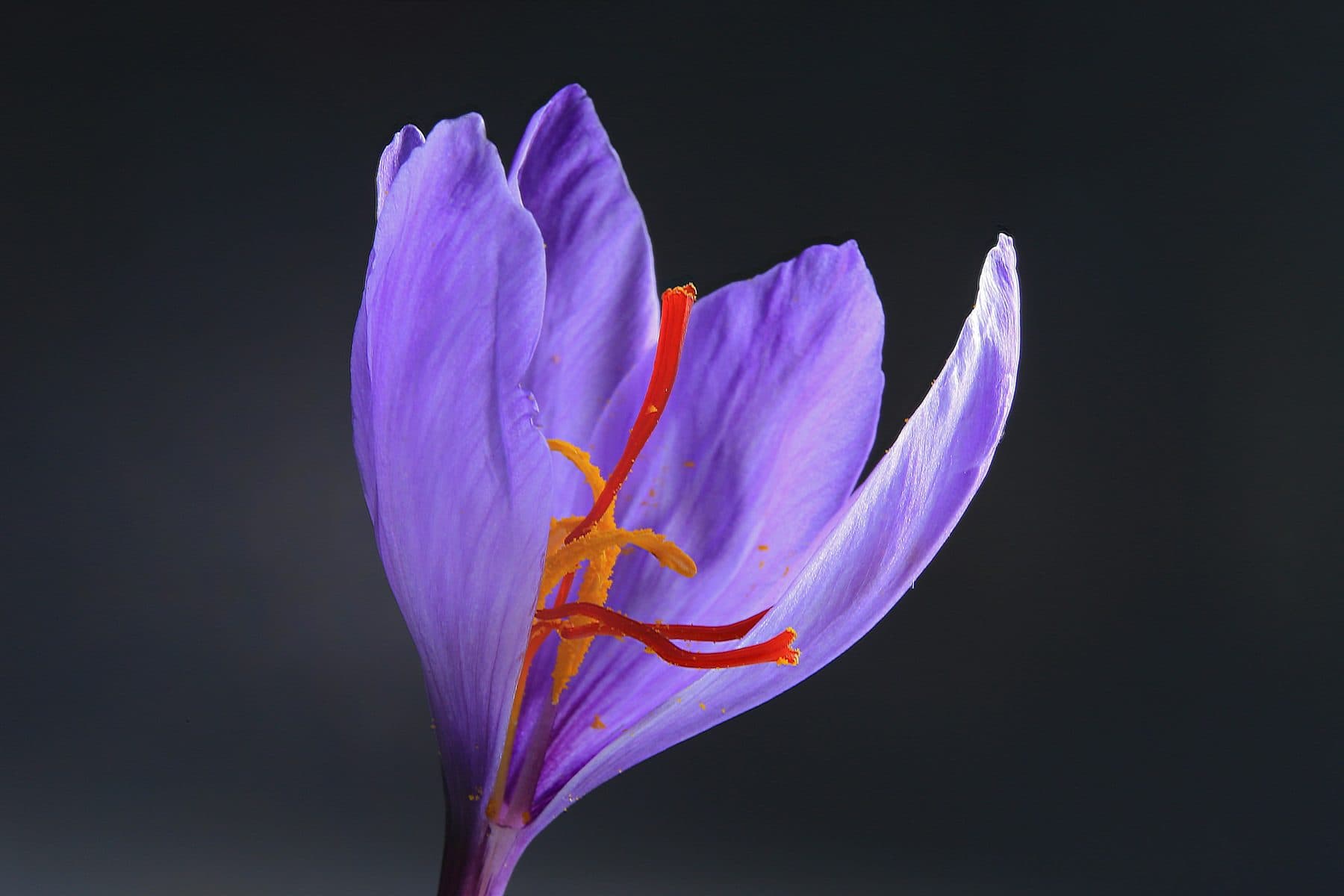
Saffron (kesar)
By THE HERB ITSELF · Updated
The red threads of kesar milk, and a spice that is often faked.
- Botanical name
- Crocus sativus
- Also called
- Kesar
- Part used
- Stigma. The thin red threads in the middle of the crocus flower.
- Body areas
- MoodSleepEyesWomen’s health
- Where it has been studied in people.
In everyday life
Kesar goes into milk, sweets and biryani, a few threads at a time.
Stefan Gafner of the American Botanical Council’s adulterants programme calls saffron “one of the most widely adulterated botanical ingredients worldwide.”
Source: NutraIngredients, 2022
What people say, and what research shows
Often said
- Better mood
- Sleep
- Premenstrual comfort
- Eyesight
- Skin glow
What research showsB
B: nine pooled trials found saffron beat placebo for mild to moderate low mood. The trials were small and mostly from Iran (Planta Medica, 2019).
What gets faked or mixed up
Other flowers
Safflower (Carthamus tinctorius), calendula and marigold are sold as saffron.
Sources: NutraIngredients, 2022 · Heyrani et al., 2025
Dyed look-alikes
Corn silk dyed with beet juice, red-dyed paper strips and silk fibres, and even plastic threads.
Source: NutraIngredients, 2022
Other red plants
Pomegranate peel or fibres, and other naturally red plant material.
Source: NutraIngredients, 2022
Other parts, or old stock
Styles and stamens (other parts of the flower), or old saffron mixed in with fresh.
Source: Heyrani et al., 2025
Added weight
Syrup, glycerin, olive oil or honey, which make the threads heavier.
Source: Heyrani et al., 2025
Powder fillers
Turmeric, paprika, salts and synthetic dyes mixed into saffron powder.
Sources: NutraIngredients, 2022 · Heyrani et al., 2025
In a 2025 lab study, 5 of 20 saffron samples bought at a market contained safflower, from 8.3% to 33.7% by weight.
Source: Heyrani et al., 2025
How to get the real one
Buy whole threads, not powder
Powder is where turmeric, paprika and other fillers hide. Threads can be looked at one by one.
Sources: NutraIngredients, 2022 · Heyrani et al., 2025
Try a pinch in hot water, as a first check
Some adulteration shows in the colour of the water. It will not catch everything, so do not stop here.
Source: NutraIngredients, 2022
Ask for the ISO 3632 grade, and an adulterant test
ISO 3632 grades saffron on aroma, flavour and colour strength. A 2021 study reports that safflower, marigold or turmeric at up to 20% by weight can slip past that approach, so ask what else was tested.
Source: De Angelis et al., 2021
Ask which methods the lab used
A full check combines several: microscopy, thin-layer and liquid chromatography, infrared and NMR.
Source: NutraIngredients, 2022
Watch out for
Origin fraud too: Kashmir’s crop is small and falling, 5.6 tonnes in 2018 (Scroll), and Iranian saffron is often sold as Kashmiri (Foreign Policy, 2026). Ask for proof of origin as well as the grade.
What has been studied
We don’t sell this herb. These cards say what researchers gave, in what form and amount, and what they found.
Mood and anxiety
Trials in adults, with saffron taken for at least four weeks.
- What was tested
- Randomised, placebo-controlled trials in adults were pooled. Saffron was the only difference between the groups, and every trial ran at least four weeks.
- What it found
- Self-rated low-mood and anxiety scores fell more with saffron than with placebo. The two clinician-rated scales (HDRS and HARS) and the POMS mood scale showed no significant difference. Results varied a lot from trial to trial, and the authors rate the certainty of the evidence as moderate.
Mahmoudi et al., 2026 · Nutritional Neuroscience
Sleep
Two trials of a standardised saffron extract (affron), taken for 28 days by adults who slept badly.
- What was tested
- Sixty-three adults who reported poor sleep took the extract or a placebo for 28 days; 55 were analysed. Sleep was tracked with the Insomnia Severity Index, a restorative-sleep questionnaire and a sleep diary.
- What it found
- The saffron group did better on all three. No side effects were reported.
Lopresti et al., 2020 · Journal of Clinical Sleep Medicine
- What was tested
- Adults with poor sleep took one of two doses of the extract, or a placebo, in the evening for 28 days. The main measure was sleep quality.
- What it found
- Sleep-quality ratings and mood on waking improved more with saffron, and evening melatonin was higher. Several other questionnaire and sleep-diary measures showed no difference, and the two doses worked about the same.
Lopresti et al., 2021 · Sleep Medicine
Eyes
Two small trials in older adults with early or mild age-related changes in the macula, the centre of the retina. Both gave saffron at 20 mg a day for three months.
- What was tested
- Twenty-five people with early age-related changes in the macula took saffron for three months and a placebo for three months, in random order. The retina’s response to a flickering light was measured.
- What it found
- Retinal flicker sensitivity improved after saffron and not after placebo. The authors say the result needs repeating.
Falsini et al., 2010 · Investigative Ophthalmology & Visual Science
- What was tested
- One hundred adults over 50 with mild or moderate age-related changes in the macula took saffron for three months and a placebo for three months, in random order. Vision and the retina’s electrical response were measured.
- What it found
- Compared with placebo, saffron improved the best-corrected eye-chart score by 0.69 of a letter and shortened the retina’s response time. The authors call the gain modest. Side effects were no more common.
Broadhead et al., 2019 · Graefe’s Archive for Clinical and Experimental Ophthalmology
Women’s health
A trial and a pooled analysis in women with premenstrual symptoms.
- What was tested
- Women with marked premenstrual symptoms took saffron capsules or a placebo for two menstrual cycles. They kept a daily symptom report, and mood was scored on the Hamilton scale.
- What it found
- The daily symptom totals and the mood score both improved more on saffron than on placebo.
Agha-Hosseini et al., 2008 · BJOG
- What was tested
- Randomised trials of saffron for premenstrual symptoms or period pain were pooled.
- What it found
- Premenstrual symptoms were lower with saffron (standardised effect −0.64), and so was period pain (−0.51), though the period-pain result only just cleared chance.
Mohammadi and Karimi, 2026 · Korean Journal of Family Medicine
Before you take it
A 2026 review of 102 trials found saffron generally well tolerated. An estimated 17.5% of people had a side effect, most often a minor stomach upset that passed, and higher doses or long use call for monitoring. If you are pregnant, check with your doctor before taking saffron as a supplement.
Source: Hasheminasab et al., 2026
Pregnant, breastfeeding or on medicine? Ask your doctor first.
Where to get it
We don’t sell saffron. This chapter is here so you can buy it well, wherever you buy it. Want us to look at another herb?
THE HERB ITSELF products are food, not medicine. This page describes traditional use and published studies. It is not medical advice, and not a promise of any outcome.