
Part 2 · 2.10 · Woods, barks and stems
Sappan wood (pathimugam)
By THE HERB ITSELF · Updated
The red wood that turns Kerala’s drinking water pink.
- Botanical name
- Caesalpinia sappan
- Also called
- Pathimugam, Pathimukham, Chappangam, Patranga, പതിമുഖം, ചപ്പങ്ങം
- Part used
- Heartwood. The dense red core of the trunk, sold as chips or shavings.
- Body areas
- CoolingGutSkin
- Where it is traditionally used.
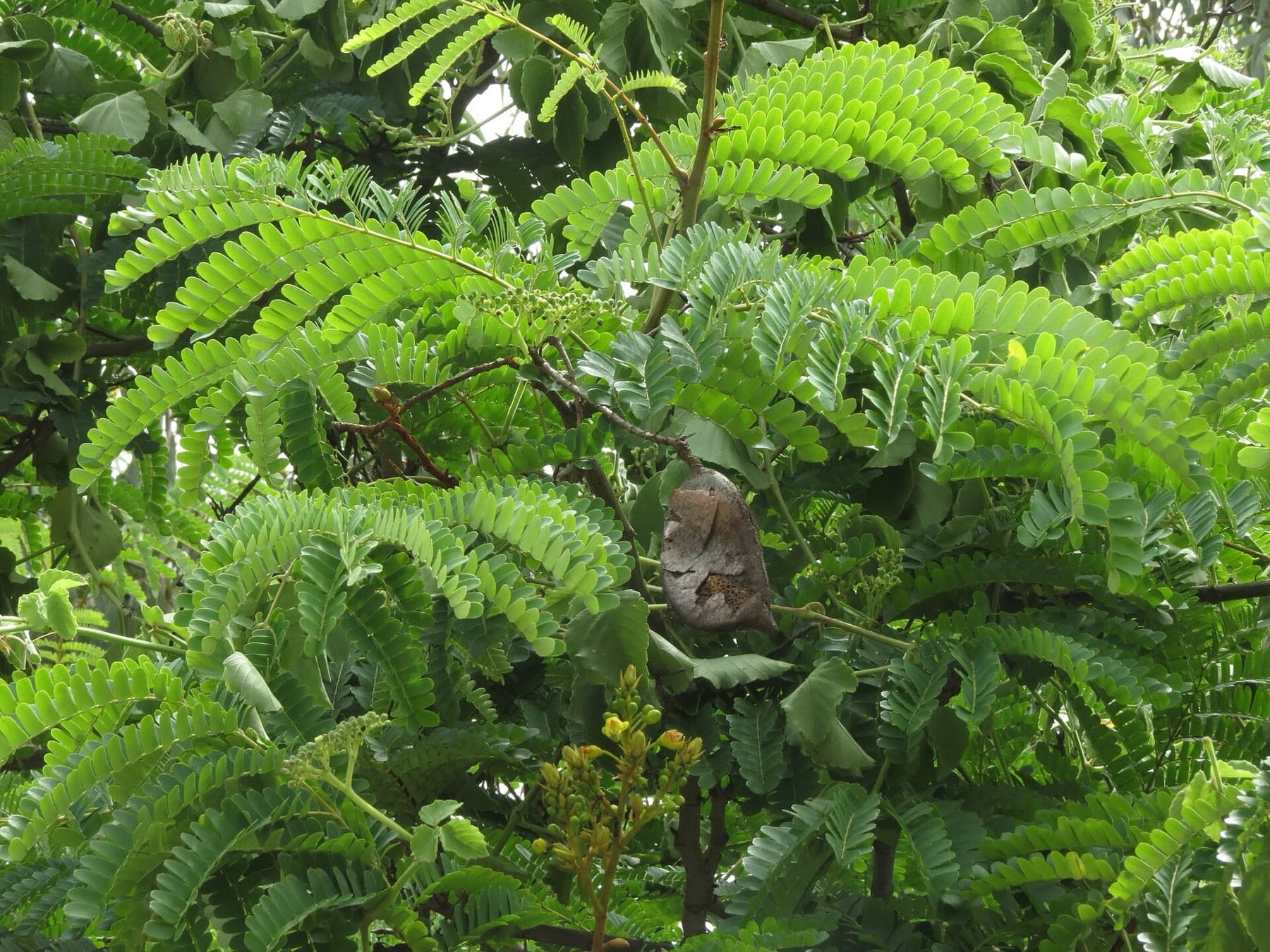
The sappan tree
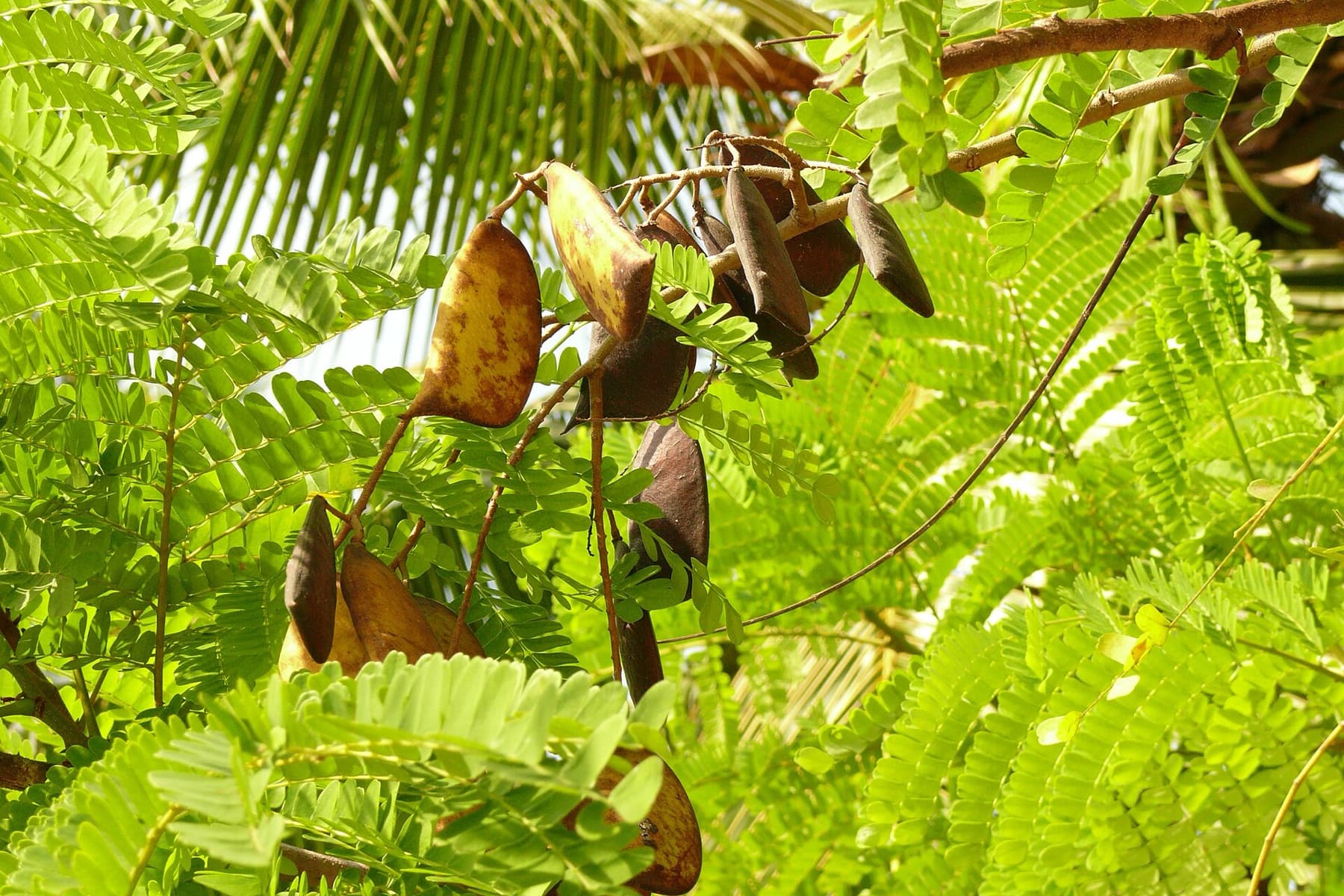
Its seed pods
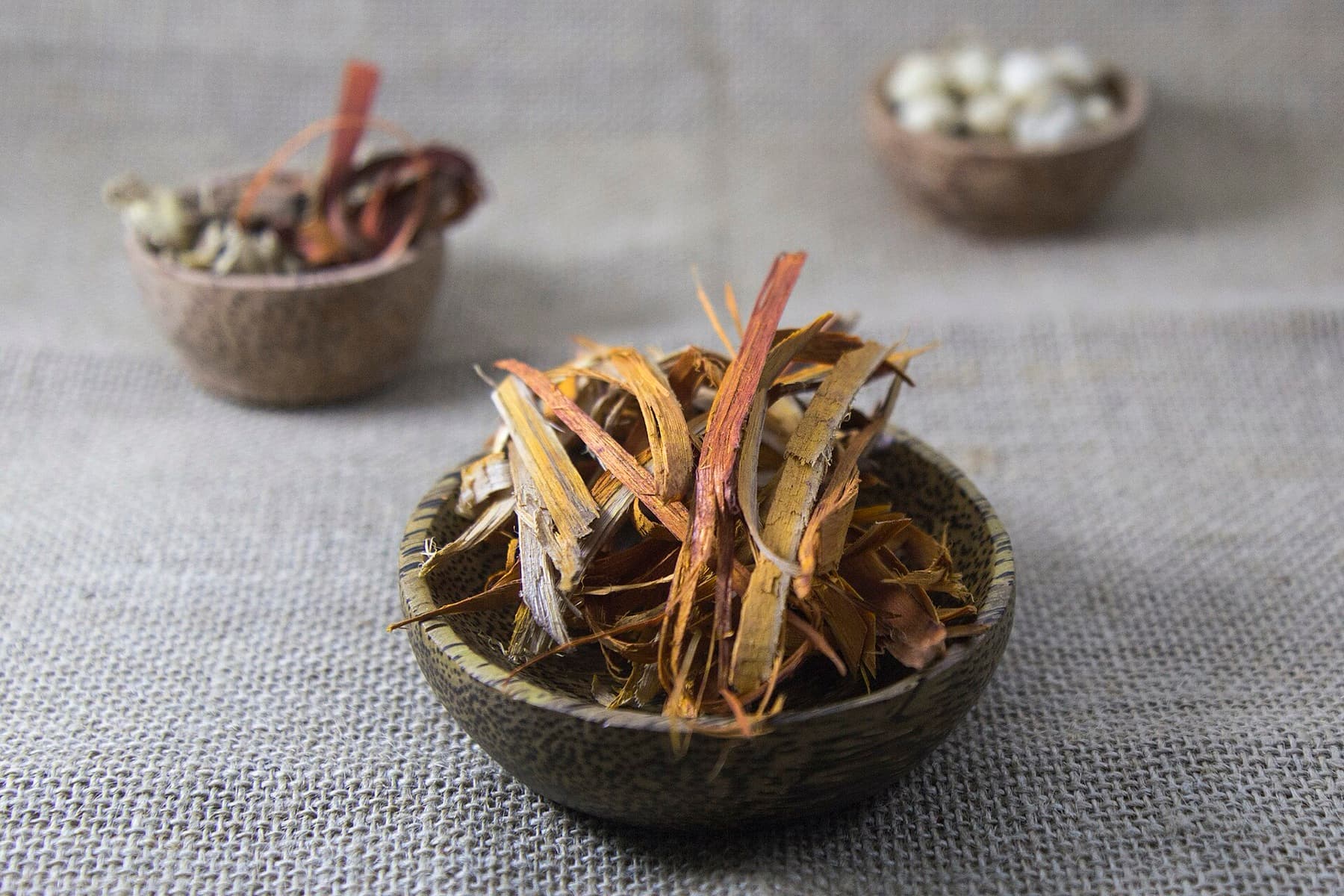
Wood chips, as sold
In everyday life
The pink water in Kerala’s homes and restaurants is usually sappan wood. A sliver or two is boiled in the pot, and the water is served warm through the day.
Restaurants began serving it instead of plain water in the 1990s. In Malayalam it is called dahasamani, a thirst quencher.
The same wood gives a natural red dye. Its pigment, brazilin, was used as a red dye in China, Japan and India.
Sources: Goya, 2022 · Down To Earth, 2020 · Asevedo et al., 2025
What people say, and what research shows
Often said
- Glowing skin
- Cooling
- Pink drinking water
What research showsD
D: lab and animal studies only. In rats, a single 5,000 mg per kg dose of extract caused no deaths, and 30 days at up to 1,000 mg per kg showed no harm (Mahidol University).
What it is traditionally used for
Cooling
Kerala’s medicinal plants board lists the wood as “refrigerant”, which means cooling.
Digestion
The same board lists the heartwood for diarrhoea and dysentery. Households say a warm glass eases the stomach after a heavy, fried meal. In rats, a water-and-alcohol extract of the heartwood protected the stomach lining in three ulcer tests, and the authors say it supports the traditional use.
Sources: State Medicinal Plants Board, Kerala · Goya, 2022 · Chellappan et al., 2017
Everyday drinking water
Kerala households and restaurants serve it as everyday drinking water, warm.
Sources: Goya, 2022 · Down To Earth, 2020
Skin
The board lists the heartwood for wounds and skin conditions, and a 2025 review says it appears in many traditional skin formulations.
Sources: State Medicinal Plants Board, Kerala · Asevedo et al., 2025
What gets faked or mixed up
Added dye
Synthetic or natural dye is added to improve the colour and look of the wood. One lab built a test for three of them: Sudan III, textile dye and red yeast rice.
Source: Batubara et al., 2022
Plain wood, stained red
A lab study of old “brazilwood” samples found one that was an inferior wood stained with the real pigment.
Source: Edwards et al., 2003
Another wood, same name
Down To Earth describes pathimukham as Himalayan cherry wood (Prunus cerasoides), a tree that does not grow naturally in Kerala, and says many pink-water mixes use sappan instead. Goya adds that untrained buyers mix sappan up with karingali (Acacia catechu) and padmaka (Himalayan cherry heartwood), which are strong medicines, not everyday drinks.
Sources: Down To Earth, 2020 · Goya, 2022
How to get the real one
Ask for the botanical name
It should read Caesalpinia sappan, also written Biancaea sappan. The name pathimugam alone can mean more than one wood.
Sources: Down To Earth, 2020 · Goya, 2022
Ask which part it is
The red core, the heartwood, is the part used for drinking water. Ask whether the pack holds heartwood, bark or a mix.
Sources: State Medicinal Plants Board, Kerala · Down To Earth, 2020
Buy pieces, not powder
Chips and shavings let you see what you are buying. A powder can hide a dye or another wood.
Ask what makes the colour
The red should come from the wood itself. Ask whether any colour is added.
Source: Batubara et al., 2022
Ask for the lab report
It should name the plant and say what was tested: what the wood is, and whether dye is present. Labs use thin-layer or liquid chromatography to find the wood’s marker compounds, brazilin and protosappanin B, and light-based tests (UV-visible or Raman) to catch added dye and stained substitutes.
Sources: Chen et al., 2010 · Batubara et al., 2022 · Edwards et al., 2003
What has been studied
Every study we cite on sappan wood. Each card says what sappan material was tested, where it was tested, and what the researchers found. Nothing here is a health claim.
Why the water turns pink
Sappan heartwood contains brazilin, which oxidises in air and water into brazilein, the red pigment.
- What was tested
- Brazilein was isolated from sappan wood, dissolved in water at three acidity levels (pH 3, 7 and 9) and then heated.
- What it found
- It was yellow at pH 3, orange at pH 7 and red at pH 9. The orange and red forms broke down when heated; the yellow form held up better.
Ngamwonglumlert et al., 2020 · Scientific Reports
Sappan wood in water
Our natural wood infusion is sappan wood steeped in water, so these are the studies closest to it: water extracts of sappan wood, measured for antioxidant activity in a test tube.
- What was tested
- Twenty dried Thai medicinal plants, sappan wood among them, were each boiled in water for 10 minutes. The water was then measured for antioxidant activity with a standard test (ABTS).
- What it found
- Sappan wood had the fifth-highest antioxidant activity of the plants ranked.
Palasuwan et al., 2005 · Asian Pacific Journal of Cancer Prevention
- What was tested
- Dried sappan heartwood powder was soaked in room-temperature water for 24 hours. The water extract was then measured in three standard antioxidant tests (FRAP, ABTS and DPPH).
- What it found
- The authors describe strong antioxidant and reducing activity. They note that earlier antioxidant results for sappan came from solvent extracts, not water.
Suwan et al., 2018 · Drug Discoveries & Therapeutics
In cells and animals
Concentrated ethanol (alcohol) extracts of sappan wood, tested on cells in a dish and in mice.
- What was tested
- Human cartilage cells and immune cells were made to inflame, then treated with the extract at different strengths.
- What it found
- The stronger the dose, the lower the inflammatory signals (IL-1β, TNF-α and nitric oxide) the cells produced.
Wu et al., 2011 · Journal of Ethnopharmacology
- What was tested
- Mice were given scopolamine, a drug that impairs memory, and then the extract (250 or 500 mg per kg of body weight) or pure brazilin (5 or 10 mg per kg).
- What it found
- The treated mice did better in a water-maze memory test: they found the hidden platform faster and spent more time in the right part of the pool. Their brains also showed higher levels of memory-related signalling molecules.
Helmi et al., 2021 · Scientia Pharmaceutica
- What was tested
- Mice were given a toxin that damages movement-controlling brain cells, a standard lab model of a movement disorder, and then the brazilin-rich extract.
- What it found
- Better movement and more protected brain cells, with less inflammation and a change in gut bacteria.
Gao et al., 2025 · ACS Chemical Neuroscience
Safety
Studies in rats and mice, and the review behind the pregnancy caution we carry.
- What was tested
- Rats were given the extract once at 5,000 mg per kg of body weight, or daily for 30 days at 250, 500 or 1,000 mg per kg.
- What it found
- No toxic signs. Behaviour, deaths, organs, blood tests and tissue examinations matched untreated rats.
Sireeratawong et al., 2010 · Journal of the Medical Association of Thailand
- What was tested
- Twenty pregnant rats per group were given the extract at 100 to 500 mg per kg on days 6 to 15 of pregnancy, and the fetuses were examined at the end.
- What it found
- Every fetus was alive, with no reabsorptions, no change in fetal weight or length and no malformations. The authors note this differs from the mouse brazilein study below and still advise caution in pregnancy.
Purnama et al., 2023 · HAYATI Journal of Biosciences
- What was tested
- A general reproductive-toxicity study of brazilein in mice.
- What it found
- No clear harm to male fertility, but more dead and reabsorbed fetuses and risk to the females. The authors advise caution for pregnant women.
Yuan et al., 2016 · Chinese Journal of Natural Medicines
- What was tested
- A review of the published toxicology, traditional use and pharmacology of sappan wood, which Chinese medicine calls Sumu.
- What it found
- The toxicology data support the traditional advice to avoid it in pregnancy, and safety depends on the dose and the type of extract.
Chen et al., 2026 · Journal of Ethnopharmacology
Before you take it
Check with your doctor first if you are pregnant, take blood-thinning medicines or have a bleeding disorder. Studies in mice and rats, and a 2026 review, are behind the pregnancy caution. Lab studies of one compound in sappan, 3-deoxysappanchalcone, found it slowed clotting in blood plasma and in mice.
Sources: Yuan et al., 2016 · Chen et al., 2026 · Lee et al., 2025 · Han et al., 2025
Pregnant, breastfeeding or on medicine? Ask your doctor first.
Where to get it
Our natural wood infusion is heartwood from Kerala and nothing else, cut and graded the same way every time. The first batch is small, and packed by hand.
Already have a pack? Check your batch.
THE HERB ITSELF products are food, not medicine. This page describes traditional use and published studies. It is not medical advice, and not a promise of any outcome.